
Opening Hour

Mon - Fri, 8:00 - 18:00

Call Us

+1.786.5852141

Email Us

sale@maykrolinc-fibers.com

Image

Welcome to Maykrolinc

45 Years Experience

Maykrol is an international distributor specializing in reinforcing fibers for concrete and asphalt, as well as steel products and innovative construction materials. Our company connects global manufacturing with construction markets, delivering high-performance materials that improve the durability, strength, and efficiency of modern infrastructure projects.

Maykrol focuses on supplying advanced reinforcement solutions used in the concrete and asphalt industries. Through international sourcing and strong supplier relationships, we provide high-quality materials at competitive prices to contractors, distributors, and industrial partners. Our expertise covers reinforcing fibers, steel products, and specialty materials used in a wide range of construction

Learn More
Image

Welcome to Maykrolinc

45 Years Experience

Maykrol is an international distributor specializing in reinforcing fibers for concrete and asphalt, as well as steel products and innovative construction materials. Our company connects global manufacturing with construction markets, delivering high-performance materials that improve the durability, strength, and efficiency of modern infrastructure projects.

Maykrol focuses on supplying advanced reinforcement solutions used in the concrete and asphalt industries. Through international sourcing and strong supplier relationships, we provide high-quality materials at competitive prices to contractors, distributors, and industrial partners. Our expertise covers reinforcing fibers, steel products, and specialty materials used in a wide range of construction

109

Expert Workers

485

Happy Clients

789

Completed Projects

890

Running Projects

Frequently Asked Questions

Concrete Fiber Reinforcement FAQs

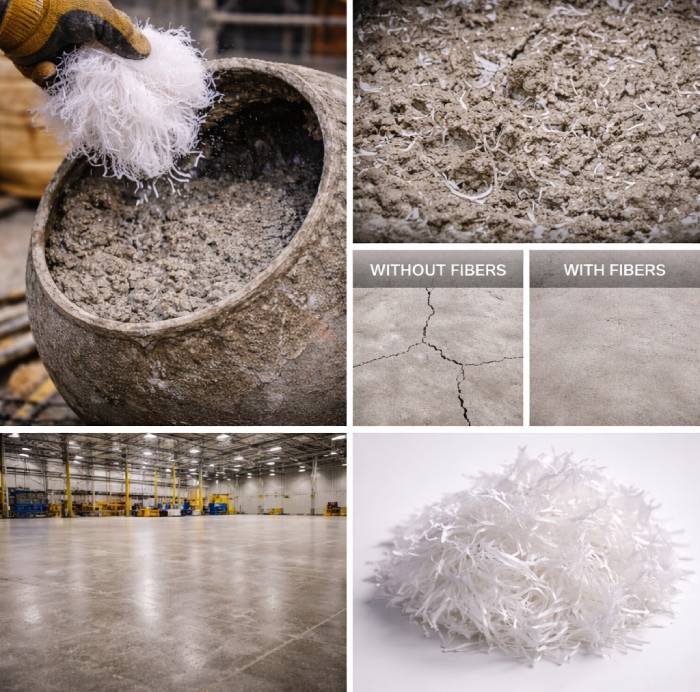
Structural macrofibers are high-performance synthetic fibers designed to reinforce concrete internally. Their engineered rough surface improves bonding with the cement matrix, creating a three-dimensional reinforcement system that distributes stresses and reduces cracking.
When mixed into concrete, macrofibers control plastic shrinkage and moisture loss, preventing weak zones where cracks typically begin. The fibers distribute tensile stresses throughout the structure, improving durability and structural performance.
Yes. Macrofibers provide tridimensional reinforcement unlike welded mesh which reinforces only fixed planes. ASTM C-1550 and ASTM C-1609 testing demonstrates that lower fiber dosages can achieve equal or superior energy absorption and residual strength compared to traditional steel reinforcement.
No. Polypropylene macrofibers have excellent chemical resistance and do not rust, oxidize, or corrode. They remain stable in humid, acidic, and alkaline environments where steel reinforcement may deteriorate over time.
Macrofibers are added directly during the mixing phase by introducing them into the concrete truck or mixer. After 5–10 minutes of mixing at maximum rotation, the fibers are fully homogenized and the concrete becomes ready for placement.
Macrofibers reduce installation time, eliminate mesh placement labor, lower transportation costs, and improve jobsite safety. They also increase toughness, energy absorption, and crack control while reducing overall reinforcement costs.
Typical applications include industrial floors, foundations, precast concrete elements, tunnels, mining structures, shotcrete, highways, pavements, and compression layers in composite slab systems.
Yes. Macrofibers are compatible with all common concrete additives including superplasticizers, water reducers, curing compounds, hardeners, and moisture control admixtures.
Recommended dosages normally range between 0.60 kg and 10.00 kg per cubic meter depending on slab thickness, structural requirements, and engineering specifications. Final dosage should always be defined by the project designer.
Yes. Synthetic macrofibers do not release rust or harmful substances into groundwater and help create lighter, more efficient structures, reducing material waste and environmental impact.